Replacing old equipment: when repair stops paying
A carousel from the nineties can be patched indefinitely. The question is whether anyone will sign it back into service afterwards.
The annual main inspection ends with a line about corrosion in the ground zone and a recommendation to repair. A year later, the same line. Two years later the welder says he can patch it, only the tube is thinner than it used to be. At that point it stops being a technical question.
Repair stops paying when it costs more than roughly half the price of a new unit, or when it touches a load-bearing member, the documentation or compliance with the standard. With carousels whose new price starts below 5 000 zł, that threshold is low and arrives sooner than intuition suggests. Replacement is also the only route when nobody can establish what loads the equipment was designed for.
Four situations where repair has no future
Age is not the criterion. A twenty-year-old structure in a dry spot, inspected regularly, is often in better shape than a five-year-old one standing in shade on wet ground with no maintenance behind it. What matters is four specific things.
The first is corrosion in a load-bearing section. Surface rust on a handrail is cosmetic. Loss of material in the post, in the hub or in the platform frame is a change in load-bearing capacity that cannot be judged by eye or restored with a weld. The blunt test: if metal in the ground zone can be punctured with a screwdriver, or sounds dull when tapped, the structure is for replacement.
The second is no spare parts. The maker has gone, the model is out of production, the bearing was made for that particular hub. Every repair then means having parts fabricated locally, and a component made outside the manufacturer's documentation puts the unit outside the scope in which anyone accepts responsibility for it.
The third is no documentation. Without instructions, a certificate and technical data, nobody knows the tightening torques, the permitted number of users or the free fall height the design assumed. You are repairing something whose parameters you do not have.
The fourth is design features that no longer meet current requirements. Gaps that trap fingers, openings in the head entrapment range, sharp edges, protruding threads, no clearance behind a swing. None of that is fixed by changing a component, because it is the geometry of the whole unit. What EN 1176 covers and how a certificate relates to it is set out in the article on the EN 1176 certificate.
Symptom against decision
| What you found | Repair | Replace |
|---|---|---|
| Paint chips, bloom rust along welds | Yes, clean and touch up | No |
| Worn swing links and hangers | Yes, replace the hanger set complete | No, provided beam and posts are sound |
| Grinding or seized carousel bearing | Yes, if the maker still supplies the part | Yes, if the part is not available anywhere |
| Cracked or bent seat, damaged platform | Yes, with a component from the maker | Yes, if the part was fabricated locally or has no replacement |
| Loss of material in a post or load-bearing frame | No | Yes |
| Cracked weld at a structural node, returning after repair | No | Yes |
| Foundation moving, unit working at its base | Yes, re-found it if the structure itself is sound | Yes, once the cost approaches the price of a new unit |
| Entrapment gaps, sharp edges, no safety zone | No | Yes |
| No certificate, instructions or maker's data | Does not solve the problem | Yes, at the first significant fault |
The arithmetic that settles it
The half-price rule is used across a lot of industries and works well for playgrounds, because the equipment is cheap relative to labour. Karuzela Tarczowa (disc carousel) costs 4 979,86 zł, Karuzela Krzyżowa (cross carousel) 4 987,69 zł and Huśtawka Ważka (seesaw) 3 997,86 zł, with free courier delivery across Poland. So a repair at 2 500 zł buys a few more years out of a worn structure instead of well over a decade out of a new one that arrives certified and under warranty.
Two items belong in that calculation and usually get left out. The first is the cost of having the unit out of service while the repair happens, which at a kindergarten or a holiday park is a real organisational problem rather than a line in a spreadsheet. The second is the probability that the same subject returns next year, because one component was replaced in a structure whose other components have exactly the same hours behind them.
On the other side of the ledger sits value the old unit does not have: complete documentation, an EN 1176 certificate, a declaration of conformity and 2 years of manufacturer warranty against material and production defects, with assembly to the instructions as the condition. It also has a stated load capacity on the rating plate, which is the figure an inspector asks for and the one an unmarked old unit cannot produce.
While a unit waits for a decision between repair and replacement, it stays out of use, marked and recorded. A deferred decision is understandable when funding is being found. A deferred decision on equipment that children are still using looks entirely different after an incident.
Assessing the unit before you decide
Most arguments about repair or replacement come from people looking at different things. A short, fixed sequence removes that, and it takes under an hour for a single unit.
- Push the post hard in four directions at waist height. Movement at the base means either loose anchor bolts or a foundation that is working.
- Work along the ground zone with a screwdriver and a light hammer, from about 15 cm below ground level to 30 cm above it. That band is where water sits and where section is lost first.
- Look at every structural node and weld under good light, with the coating cleaned back where there is bloom rust. Cracks run along the toe of the weld, not across the middle of a tube.
- Spin the empty platform and listen. Grinding, stepped resistance and lateral run-out all point at the bearing, which is the one part that genuinely wears.
- Open the file. Instructions, certificate, rating plate, inspection records. What is missing here decides more than anything found on the structure.
Anything found in steps one to three that involves loss of section moves the unit into the replacement column regardless of what the rest of it looks like. Everything found in step four is a repair, and the routine that keeps units out of this conversation for years is described in the article on carousel maintenance.
Old equipment with no paperwork
This is the commonest situation on sites built before 2010. The unit is standing, nobody knows who made it, there is no file. Certification applies to placing a product on the market, so continuing to use the equipment is not in itself a breach. The difficulty starts at two moments: at an inspection, when the site documentation has to be produced, and after an accident, when the operator has to show the equipment met safety requirements.
There are two ways out. You can commission a conformity assessment of the existing unit from a body that inspects playgrounds and receive a document describing its condition together with a list of non-conformities. Or you can treat that assessment as the first step towards replacement, because on equipment from the nineties the list of non-conformities is usually longer than the list of things worth repairing.
The old unit and its foundation
Taking the structure down is normally the smaller problem. What stays underground is the larger one. The old foundation has to come out if the new unit goes in the same place, or if the concrete would stand proud of the ground inside the impact area. An exposed corner of concrete is a hard obstruction in the safety zone and counts as a defect on its own, whatever is standing above it.
A replacement is also the moment to re-check the location, because surroundings change over the years: trees have grown, a path has appeared, a bench has been added. A new unit needs 2 m of clear ground around it, and above a free fall height of 60 cm the impact attenuating surfacing requirement under EN 1177 applies as well. How the zones are measured is in the article on the playground safety zone.
Steel goes for scrap and will fetch something, though for a single unit the amount is symbolic. Timber equipment leaves you with the disposal of treated wood, which cannot go into a domestic stove.
One unit or the whole site
When one carousel qualifies for replacement and a swing and a slide of the same vintage stand next to it, the temptation is to do everything at once. Sometimes that is right, and what settles it is the condition of the other units rather than their age.
In favour of replacing one unit: it fits inside a running maintenance budget, needs no separate design work and can be done in a few weeks. In favour of doing the whole site: the fixed costs spread badly across a single unit, meaning the crew's travel, the plant for breaking out foundations and any resurfacing of the impact area. If the site needs new impact attenuating surfacing anyway, laying it twice costs more than laying it once.
A practical way through the decision: list every unit from the last main inspection record and put one of three answers against each, namely replace now, replace within two years, sound. If the first two groups cover more than half the site, plan a full refurbishment. If they cover less, replace selectively and revisit after the next inspection. Choosing what goes back in is covered in the article on types of playground equipment.
We have been making metal carousels and seesaws since 2011, so parts for our equipment are still available years after purchase. A new unit ships with an EN 1176 certificate, a declaration of conformity, the instructions and 2 years of manufacturer warranty, with free courier delivery across Poland and a lead time of 7 working days. Assembly needs a concrete foundation and two people, and our crew will do it for 2,50 zł per kilometre one way from Rogowo, which you can price in the delivery and assembly calculator. See the range and prices.
Short answers
When is replacing playground equipment cheaper than repairing it?
The practical line sits at about half the price of a new unit. With a carousel under 5 000 zł that means a repair costing 2 500 zł or more rarely makes sense, because you are buying a few more years out of a worn structure instead of well over a decade out of a new one.
Can equipment without any certificate stay in use?
In itself yes, because certification applies to placing a product on the market rather than to operating it. The difficulty appears at an inspection and after an incident, when the operator has to show the equipment meets safety requirements and has no document to show.
Does the old foundation have to come out?
Yes, if the new unit goes in the same spot or if the concrete would stand proud of the ground inside the impact area. An exposed corner of an old foundation is a hard obstruction and counts as a defect on its own.
How long does a replacement take once the decision is made?
Our lead time is 7 working days, 5 in production and 2 in transport, and courier delivery is free across Poland. The site work adds the removal of the old unit and its foundation, plus the days the new concrete needs to gain strength.
What this is based on
- EN 1176-1: playground equipment, general safety requirements
- EN 1176-7: guidance on installation, inspection, maintenance and operation
- EN 1177: impact attenuating playground surfacing
- Manufacturer's assembly and operating instructions supplied with the unit
Equipment mentioned in this article
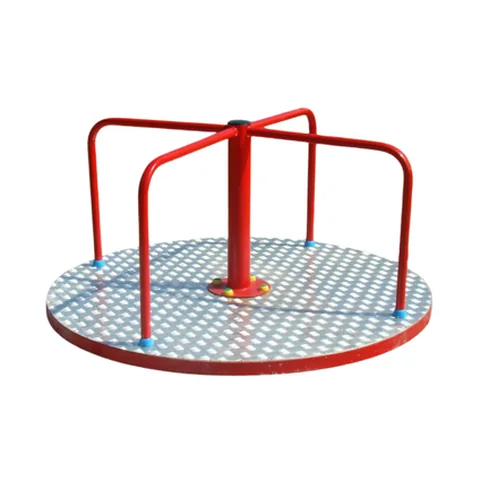
Karuzela Tarczowa
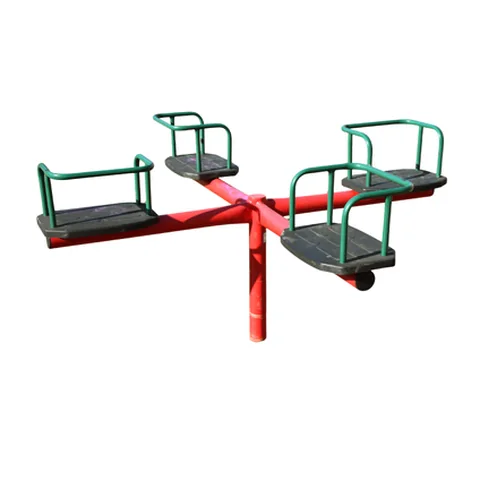
Karuzela Krzyżowa
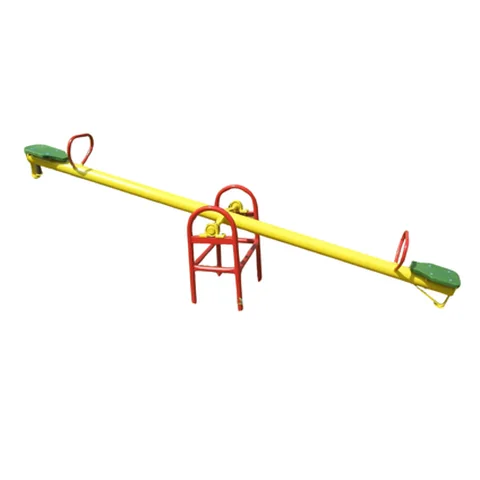
Huśtawka Ważka
Need certified equipment?
We make carousels and seesaws in Rogowo, Poland. EN 1176 certificate and the full paperwork included, free delivery across Poland, 7 working days lead time.
Read next
Installing a carousel: foundation, concrete, time
A carousel is set on a concrete foundation, levelled twice and left until the concrete cures. What to prepare, how the job runs, when children can go on.
Assembly and upkeepCarousel maintenance: what to check and how often
A working list for carousels and seesaws: tightening fastenings, judging the bearing, checking links and hangers, touching up the coating. With a schedule.