Types of playground equipment: fit, age and cost
Catalogues show dozens of units and none of them says plainly how they differ in use. The differences come down to three things: how many children each takes at once, how much ground it eats, and what it costs to keep over ten years.
The question of what to buy for a playground almost always comes from somebody who already has a fixed plot and a fixed budget. The answer is rarely a multiplay unit, because a multiplay unit consumes both at once.
Playground equipment falls into six basic categories: carousels, swings, seesaws, spring riders, multiplay units and rope structures. They differ in how many children they take, in the safety zone they demand and in what they cost to maintain. Prices for certified metal equipment start at around 1 500 zł for a spring rider and run into tens of thousands for a large multiplay structure.
The categories side by side
| Category | Age | Children at once | Ground including the zone | Indicative price |
|---|---|---|---|---|
| Carousel | 3-14 years | 4-8 | about 5,5 x 5,5 m | 4 000-6 000 zł |
| Seesaw | 3-10 years | 2-4 | about 6 x 5 m | 4 000-5 000 zł |
| Swing | 1-14 years, depending on the seat | 1-2 per seat | about 7 x 4 m | 3 000-6 000 zł |
| Spring rider | 1-6 years | 1 | about 3 x 3 m | 1 500-3 000 zł |
| Multiplay unit | 3-12 years | 6-15 | from 10 x 8 m | from 15 000 zł |
| Rope structure | 6-14 years | 5-10 | from 8 x 8 m | from 12 000 zł |
The ground figures include the safety zone, because the zone is what decides whether a unit fits on the plot at all. Prices are indicative for certified metal construction. The footprint of any particular unit of ours we confirm on request.
Carousels: the most children on the least ground
A carousel takes four to eight children at once on less ground than a two-seat swing needs. That is the best ratio of users to square metres in this price bracket, which is why carousels turn up where space is short and children are many: school grounds, housing estates and holiday parks.
Three variants come up most often. The round carousel has a platform with a handrail around the perimeter, so children can stand or sit and the rail closes the space off, which makes it the hardest of the three to fall out of. The cross carousel has four seats on arms, a low, simple structure where each child sits separately with its own handhold. The disc carousel is a rotating platform with handrails and nothing else, so it has the fewest moving parts and the lowest maintenance. The differences are set out in the article comparing carousel types.
The number that governs use is not the count of handholds but the load capacity on the rating plate. Ours run 200 kg on Karuzela Kołowa Trzmiel (round carousel), 180 kg on Karuzela Tarczowa (disc carousel), 160 kg on Karuzela Krzyżowa (cross carousel) and 100 kg on Huśtawka Ważka (seesaw). What those figures mean in terms of children on the platform is explained in the article on carousel load capacity.
Swings and seesaws are two different problems
A swing is a beam with seats hanging from it. It looks modest and has the most demanding safety zone of anything on this list, because the clear space is measured in the direction the seat travels and with a 2 m suspension it can reach well over 3 m in front of and behind the frame. On a narrow plot it is usually that zone, not the frame, that settles whether a swing fits.
A seesaw works differently: two children at opposite ends of a beam, vertical movement, nothing suspended. The safety zone is compact and the structure is low, and the unit forces two children to cooperate, which with younger groups has a value of its own.
Spring riders: for the youngest and nobody else
A spring rider is the cheapest certified unit you can buy and the only sensible one for children under three. It serves one child and takes around 3 x 3 m with its zone. Bought on its own it rarely makes sense. It works as a supplement: a carousel for the older children, two spring riders for the toddlers beside the same sandpit.
Multiplay units: when they genuinely pay
A tower with a slide, a ramp and a climbing wall photographs best in a catalogue and is usually the first idea. Two things are worth calculating before committing to one.
The first is ground. A unit with a slide needs zone at the slide run-out as well, which in practice means from 10 x 8 m. The second is surfacing. A slide and a tower push the free fall height above 60 cm, and above that threshold EN 1177 requires impact attenuating surfacing. Sand, gravel or tiles across the whole zone is a cost that can match the price of the equipment itself, as set out in the article on playground surfacing.
A multiplay unit makes sense above roughly 25 000 to 30 000 zł of budget, on a site where you do not have to count every metre. Below that, two or three separate units will serve more children for the same money.
Matching equipment to age
| Age group | What works | What to avoid |
|---|---|---|
| 1-3 years | Spring riders, swings with cradle seats, sandpit | Anything that requires keeping your own balance |
| 3-6 years | Carousels, seesaws, low multiplay units, swings with backrests | Climbing structures and heights above 1 m |
| 6-12 years | Carousels, swings, towers with slides, rope structures | Toddler equipment, which wears out fast under heavier users |
| Over 12 years | Rope structures, agility equipment, outdoor gym | Placing them in the same zone as toddler equipment |
Steel or timber
Timber photographs warmly and turns up in most visualisations. Steel wins in service: it does not split, it does not rot at ground level and it needs no annual treatment. A galvanised, powder coated structure stands for well over a decade with nothing beyond tightening its connections.
Timber needs its ground contact watched, because that is where rot starts, and its coatings kept up. For a municipality or a school with nobody on staff doing routine maintenance, that is a real difference in cost across a decade. The comparison is set out in the article on steel or timber playground equipment.
What every unit needs, whatever the category
- A certificate to EN 1176 and a declaration of conformity, without which a public project does not get signed off
- Assembly and operating instructions from the manufacturer
- A clear safety zone, which cannot include a fence or another unit
- A rating plate carrying the maker, the year of manufacture and the standard
- Inspections to EN 1176-7: routine visual checks, functional checks every 1 to 3 months and an annual main inspection
The order in which to make the decisions
- Measure the plot and subtract the safety zones. Only what is left is the space you actually have
- Settle which age groups the site is for
- Check whether the units you are considering exceed a free fall height of 60 cm, because that decides the surfacing
- Only then choose specific models and compare prices
The reverse order, starting with a unit from a catalogue, usually ends halfway through the project with the discovery that the safety zone runs into the footpath or the fence.
We make carousels and seesaws: four metal structures, all certified to EN 1176, with a declaration of conformity and the instructions in the price. Courier delivery is free across Poland and the lead time is 7 working days. Assembly needs a concrete foundation and two people, done by your team or by our crew. See the range and prices, or send your plot dimensions and the ages of the children through the quotation form and we will tell you what fits.
Short answers
Which playground units are chosen most often?
Carousels, swings and seesaws. Those three categories are bought most because they take several children at once, fit on small sites and have the lowest running cost per child using them.
How much ground does one unit need?
The footprint plus the safety zone, which for a carousel means 2 m of clear ground on every side. For a swing the zone extends further in the direction the seat travels, so a narrow plot often rules a swing out before a carousel.
Which equipment suits the youngest children?
Spring riders and swings with cradle seats, from around 1 to 3 years. Carousels and seesaws normally start at 3 years, and climbing structures at 5 or 6.
How many children can a carousel carry at once?
That is set by the load capacity on the rating plate rather than by the number of handholds. Our units are rated at 200 kg for Karuzela Kołowa Trzmiel, 180 kg for Karuzela Tarczowa, 160 kg for Karuzela Krzyżowa and 100 kg for Huśtawka Ważka.
What this is based on
- EN 1176-1: playground equipment, general safety requirements
- EN 1176-2 to EN 1176-6: additional requirements for swings, slides, carousels and rocking equipment
- EN 1177: impact attenuating playground surfacing
Equipment mentioned in this article
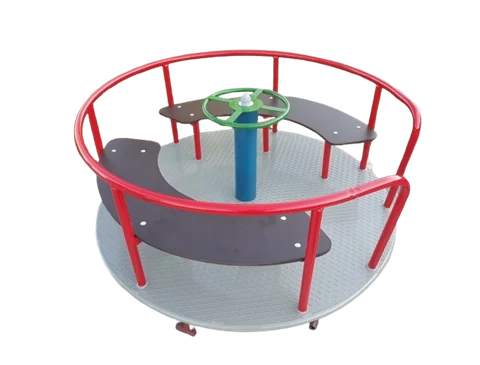
Karuzela Kołowa Trzmiel
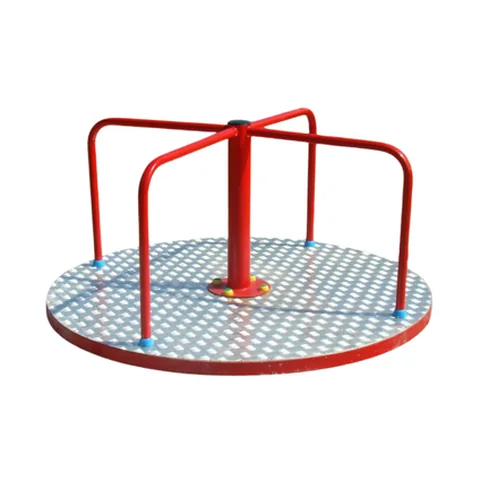
Karuzela Tarczowa
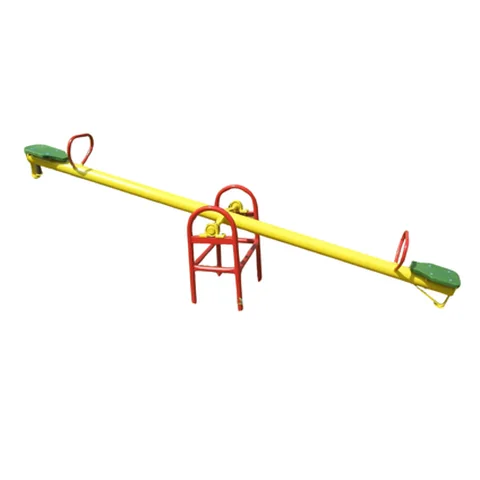
Huśtawka Ważka
Need certified equipment?
We make carousels and seesaws in Rogowo, Poland. EN 1176 certificate and the full paperwork included, free delivery across Poland, 7 working days lead time.
Read next
How many children fit on a carousel: capacity, age
Load capacity is stated in kilograms, not in children. How to turn 160-200 kg into a number of children, what limits the places and why an adult upsets it.
Choosing equipmentRound, cross or disc carousel: which one to choose
The three types of carousel differ in load capacity, the ages they suit and how much ground they take. A side by side table plus what works where.