Carousel maintenance: what to check and how often
Equipment does not fail suddenly. It fails over two seasons, and the first sign shows within months if somebody walks up with a spanner and looks.
A carousel is into its second spring and from ten metres away it looks exactly as it did on the day it went in. Close up, one bolt at a handhold has backed off a quarter turn, and there is a scrape on the post where a bicycle handlebar caught it. Together the two take a quarter of an hour, if somebody notices them in spring rather than in autumn.
Maintenance on playground equipment comes down to four things: checking bolted connections, judging how the bearing runs, sealing damage to the coating and looking at the foundation. The first three are monthly work in season, the fourth is annual, best done in spring before the site reopens. For a single unit the monthly round is a quarter of an hour, a spanner, a cloth and a touch-up stick in the right colour.
This article is about the work done with hands. The formal side, meaning who is entitled to carry out which inspection and what has to go into the records, sits in the article on playground inspections. That one covers the obligations, this one covers the tasks.
Schedule by frequency
The table below is a starting point. For a unit used by twenty children a day the frequencies are as given. For a carousel at a holiday park open two months a year, everything except the routine walk round moves one level less frequent.
| Task | How often | What you are looking for |
|---|---|---|
| Routine visual walk round | Daily to weekly, depending on use | Glass, litter, missing dome nuts, fresh deformation, signs of vandalism |
| Bolted connections | Monthly in season | Play at handholds, handrails, seats and the platform mounting |
| Spin test on the platform | Monthly | Grinding, snatching, stepped resistance, lateral run-out you can feel |
| Swing links, hangers and hooks | Monthly in season | Worn links, elongated holes, opened hooks, loose retaining devices |
| Seats and platform | Quarterly | Cracks, sharp edges after an impact, perforations blocked with debris |
| Paint coating | Quarterly | Chips, deep scratches, blisters, discolouration along weld edges |
| Greasing the bearing | Per the instructions, usually once a season | Type and quantity come from the instructions for the unit, not from a shop shelf |
| Foundation and ground zone | Annually, in spring | Movement under pressure, exposed concrete, washed-out ground, corrosion at the base of the post |
| Safety zone and surfacing | Annually and after any change nearby | A new bench, bollard, tree or unit closer than 2 m to the carousel |
| Rating plate and site rules | Annually | Legibility, fixing, a phone number for reporting faults that still works |
Bolted connections always loosen
A carousel works under varying loads. Children spin it up, brake with their feet, jump on while it is moving and hang off one side of the handrail. Every one of those jolts goes into the connections, and after a few hundred hours of play some of them have play in them.
The work looks like this: a spanner on each fastening in turn, always in the same order so none gets missed. Tightening torques come from the instructions for that unit, because they depend on the diameter and grade of the bolt, and tightening by feel ends either in more play or in a stripped thread. While you are there, check two things. Are all the dome nuts still in place, and is there an arc-shaped scuff in the paint under a bolt head. That scuff means the joint has already been turning.
If the same connection loosens every month, the problem is not the bolt but what it holds: an elongated hole, a bent bracket or a structure that is working. At that point you call the manufacturer rather than tighten it a fourth time.
The bearing gives warning before it fails
On a carousel this is the most expensive moving part and the only one that genuinely wears. The test is simple and needs no tools. Spin the empty platform by hand and listen. A healthy carousel turns evenly, quietly, and coasts for a long time. Four symptoms call for action straight away:
- grinding or rasping that builds with each revolution
- stepped resistance, where the platform slows and speeds up at the same point
- lateral run-out you can feel when you take the handrail and pull sideways
- a platform that stops noticeably sooner than it did last season
The commonest cause of early wear has nothing to do with the quality of the bearing. It is a post set out of plumb, which sends the load through one side. The second is sand, which at a carousel standing next to a sandpit gets everywhere and works like abrasive paper. The installation sequence and what the ground under the unit has to do are covered in the article on the carousel foundation.
Grease to the instructions for the unit. There is no universal product that suits every bearing, and forcing an arbitrary grease into an assembly designed for another can shorten its life rather than extend it. Remove the old grease with the sand it has collected before applying new, otherwise you are simply adding a fresh layer on top of the abrasive.
Swings: links, hangers and the points between them
On a swing it is not the beam that wears, it is the places where metal touches metal. A chain link rubs its neighbour, a hook rubs the eye of the hanger, a pin works in its bush. All of them thin slowly and evenly, so comparison with an adjacent unloaded component tells you more than a vernier caliper does.
Monthly in season you check five things: whether the links nearest the hook are flattened and worn, whether the hook has opened enough to change its gap, whether the retaining device is still in place, whether the seat hangs level, and whether there are cracks in the rubber or in the seat fixing. A link worn through a visible part of its section is replaced together with the rest of the hanger, not on its own, because the others have the same hours behind them.
A visible crack, an opened hook or a missing retaining device is reason to take the unit out of service the same day. Hazard tape and a printed notice cost almost nothing, and they also demonstrate that the operator reacted. Everything after that, from the record to the repair, is easier because the unit was closed first.
Touching up the coating
A chip in the finish on galvanised, powder coated steel is not a failure. Under the paint there is zinc, which goes on protecting the steel, so you have until the next walk round rather than until tomorrow. Leaving it for two years is a different story, because exposed zinc is consumed faster than zinc under a coating.
The repair goes like this: clean loose coating and dirt off the spot, dry it, degrease it, apply a thin coat of touch-up in the colour of the unit and let it dry before children come back. It is only worth doing in dry, warm weather, because paint laid on a damp surface lifts in sheets at the first frost. How zinc and powder coating work together, and why the order of those layers decides everything, is set out in the article on powder coating and galvanising.
Look at edges and welds separately. That is where the coating is thinnest and where the first discolouration appears. A rusty bloom next to a weld does not weaken the structure by itself, but it marks a spot worth returning to every quarter.
The foundation and what sits below ground
Once a year, best in spring, you check what stays hidden the rest of the season. Take the post at waist height and push hard in four directions. The structure should not move at its base. If it does, either the anchor bolts have loosened or the foundation is working, and the matter has moved beyond maintenance.
The second thing is the ground level around the base. Water running off the platform washes soil away over the years and exposes the concrete. An exposed corner of a foundation is a hard edge in the impact area, which is precisely what the standard does not allow. The fix is trivial: add material and compact it, or top up the impact attenuating surfacing.
The third is the zone itself: 2 m of clear ground around the unit, with no benches, bins, fence posts or other equipment in it. That zone has a habit of shrinking on its own, because somebody adds a bench or plants a shrub. Above a free fall height of 60 cm the surfacing requirement under EN 1177 applies as well, and loose materials such as sand and wood chips compact over time and lose depth, which is why the depth is measured rather than eyeballed. How the different materials behave is set out in the article on playground surfacing.
Write it down, even when you found nothing
A note after a walk round takes a minute: date, who checked, what was done, what needs watching. An entry reading “two bolts tightened at the handhold, nothing else to report” is worth more than the memory of a caretaker three years later, when someone asks about the history of the unit. Maintenance records go into the same file as the inspection records, and if a claim or a warranty question comes up they are the first evidence that the equipment was looked after.
A log also shows trends that a single walk round cannot. If the same connection appears in the records three times in a season, you have a concrete argument to put to the manufacturer instead of an impression that something keeps working loose.
Every unit we make comes with assembly and operating instructions listing the points to check, an EN 1176 certificate and a declaration of conformity, at no extra charge. The 2-year manufacturer warranty covers material and production defects, with assembly to the instructions as the condition. If the instructions for a carousel bought years ago have gone missing, call 507 440 718 or write to kontakt@bol-met.pl, we answer daily between 08:00 and 20:00. The range and prices are in the shop.
Short answers
How often should a carousel bearing be greased?
Usually once a season, following the instructions for that particular unit. More often where the carousel is heavily used or stands next to a sandpit, because blown sand acts as an abrasive.
How do you deal with a chip in the paint?
With a touch-up in the colour of the unit, applied to a surface that has been cleaned, dried and degreased. On galvanised steel a chip exposes zinc rather than bare steel, so it is not an emergency, but it should be closed at the next walk round.
Can a caretaker or a council worker do the maintenance?
Yes. Routine walk rounds and monthly tasks need training and the operating instructions, not a qualification. The annual main inspection under EN 1176-7 is a separate matter and is carried out by someone with the right technical background.
What if the carousel starts to grind when it turns?
Take it out of service and check the bearing and the plumb of the post. Grinding and snatching usually run weeks ahead of a failure, so there is time to react, but not a whole season of it.
What this is based on
- EN 1176-1: playground equipment, general safety requirements
- EN 1176-7: guidance on installation, inspection, maintenance and operation
- EN 1176-5: additional safety requirements for carousels
- EN 1176-2: additional safety requirements for swings
- Manufacturer's assembly and operating instructions supplied with the unit
Equipment mentioned in this article
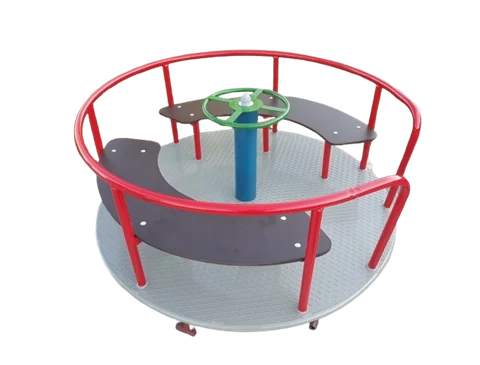
Karuzela Kołowa Trzmiel
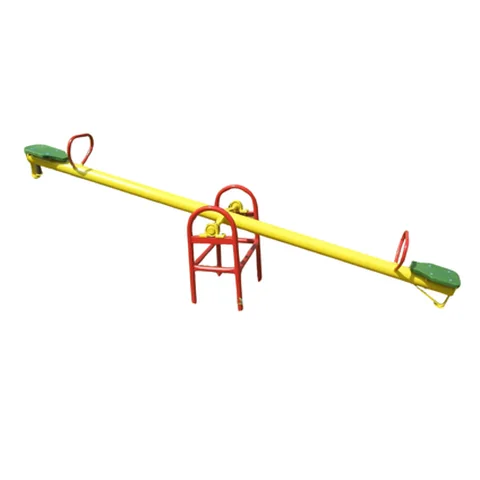
Huśtawka Ważka
Need certified equipment?
We make carousels and seesaws in Rogowo, Poland. EN 1176 certificate and the full paperwork included, free delivery across Poland, 7 working days lead time.
Read next
Installing a carousel: foundation, concrete, time
A carousel is set on a concrete foundation, levelled twice and left until the concrete cures. What to prepare, how the job runs, when children can go on.
Assembly and upkeepDIY or professional assembly: cost, risk, warranty
What you need to install a carousel yourself, what our crew costs, which assembly mistakes fall outside the warranty and who signs off the inspection.