Playground safety zone: how much ground you need
The commonest mistake in playground planning is to measure the unit and leave it exactly as much room as it occupies. Then the post-installation inspection arrives and the carousel turns out to be standing too close to the fence.
A carousel measuring 150 × 150 cm needs a plot of 550 × 550 cm. That is over 30 square metres for a unit that occupies less than two and a half. The difference surprises almost everybody planning a playground for the first time.
The rule is straightforward: the footprint of the unit plus 2 metres on every side. We checked the data sheets of several makers of equipment in the same class and the arithmetic is identical everywhere: unit dimension + 400 cm.
Where the two metres come from
The safety zone is not a decorative margin. It is the space a child travels into after letting go of the handrail on a carousel at speed. EN 1176-5, the part of the standard covering carousels, assumes that centrifugal force will throw the child clear of the platform, and it sets out an area that has to stay empty so the fall ends on grass rather than on a kerb.
Nothing from this list may sit inside the zone: a fence, a bench, a bin, a post, a lamp column, a tree, a kerb, a low wall or another piece of play equipment. A hard obstacle in that spot is exactly what the standard exists to prevent.
The zone is measured from the edge of the unit outwards, on the ground, in every direction. It is not a circle drawn around the centre post, which is the version people tend to sketch by hand and which comes out too small on the corners.
Real figures for typical units
The table below is taken from published product sheets for equipment in the same class as ours. We give it so you can size up a site before settling on a particular model.
| Type of unit | Unit footprint | Zone required | Area |
|---|---|---|---|
| Three arm disc carousel | 120 × 120 cm | 520 × 520 cm | 27 m² |
| Four arm disc carousel | 150 × 150 cm | 550 × 550 cm | 30.3 m² |
| Four arm cross carousel | 166 × 166 cm | 566 × 566 cm | 32 m² |
| Tall post carousel | 350 × 350 cm | 950 × 950 cm | 90.3 m² |
Comparative market data, not the parameters of Bol-Met units. We confirm the exact dimensions of our carousels by email before an order, together with the foundation drawing.
How to work it out on your own plot
Measure the clear rectangle that has nothing hard inside it. Subtract 2 metres from each side. What is left is the largest footprint of equipment that will fit there.
An example from a municipal site we supplied: a plot of 7 × 6 metres with a hedge along one side. After the zone was subtracted, 3 × 2 metres were left for the unit itself. A carousel of 150 × 150 cm went in without trouble, but a seesaw over 3 metres long did not, in any orientation, because the longest remaining dimension was exactly 3 metres. It ended with a section of hedge being cut back.
Send us the dimensions of the plot with your enquiry and we will do this arithmetic for you, in both orientations, before anything is ordered. The enquiry form takes a minute and it is a cheaper way to find out than discovering it at unloading.
Two units next to each other
The zones of a carousel and a seesaw must not overlap. If you are planning both, calculate each zone separately and add them together. With a carousel of 150 × 150 cm and a seesaw you realistically need a dozen metres or more of clear space in line, not a few.
This is where most crowded sites go wrong. Two units bought at the same time get placed as a pair, three metres apart, because that looks tidy on the drawing. On the ground it means each unit is standing inside the other one's fall space.
Surfacing: when it becomes compulsory
What decides is the free fall height, that is the distance from the highest point a child can stand on down to the ground. Above 60 cm, EN 1177 requires impact attenuating surfacing: sand, gravel of a suitable grading, wood chips or a polyurethane system with tested performance.
Platform carousels usually come in around 45 cm, below the threshold, which means they can go straight onto grass with no groundworks. Check the data sheet for your unit, though, because post carousels with raised seats can reach 70 cm and then surfacing is unavoidable. The cost difference between those two cases is set out in the piece on playground surfacing.
What the post-installation inspection looks at
Whoever carries out the inspection after assembly measures the zone with a tape and checks for obstacles inside it. If there are any, the unit is not released for use and the report goes into the handover file with a finding against it. Putting it right usually means moving a bench or shifting a fence, which costs more in nerves than in money but can delay the opening of the site by weeks.
Space is only one of the three numbers worth settling before you order. The other two are the age of the children and how many of them use the unit at once, and those are covered in the piece on carousel load capacity.
Every one of our carousels keeps a 2 m safety zone measured from the edge of the unit. Send the dimensions of your plot and the age of the children with your enquiry and we will say straight away what fits, including the option of turning the unit through 90 degrees. Call 507 440 718, we answer every day from 08:00 to 20:00, or see the four units with prices.
Short answers
How much space does a playground carousel need?
The footprint of the unit plus 2 metres on every side. A carousel of 150 × 150 cm needs 550 × 550 cm of clear ground, which is 30.25 m².
Can a bench or a fence stand inside the safety zone?
No. The zone has to be free of obstacles: fences, benches, bins, trees, posts and other equipment. It is the space a child falls into, not simply the ground around the unit.
Can the safety zones of two units overlap?
Not for carousels and swings. Each needs its own separate zone, otherwise a child thrown off one unit lands on the other.
When does a carousel need impact attenuating surfacing?
When the free fall height is over 60 cm. Platform carousels usually sit at about 45 cm, so the requirement does not catch them, but always check the data sheet for the particular model.
Does the safety zone have to be fenced?
No, and a fence placed inside the zone is a defect rather than an improvement. If the site is fenced, the fence line has to sit outside the zone of every unit.
What this is based on
- EN 1176-1: playground equipment, general safety requirements
- EN 1176-5: additional requirements for carousels
- EN 1177: impact attenuating playground surfacing
- General guidance for playground owners and site managers
Equipment mentioned in this article
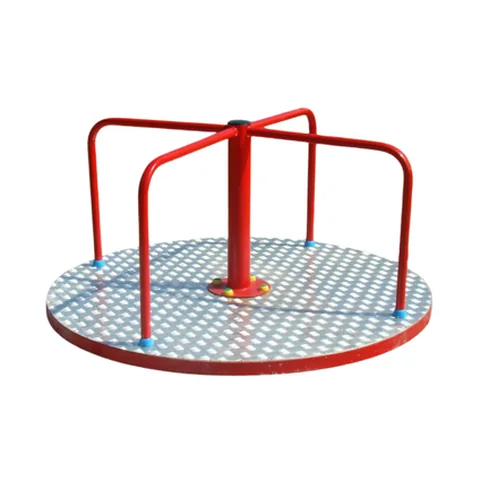
Karuzela Tarczowa
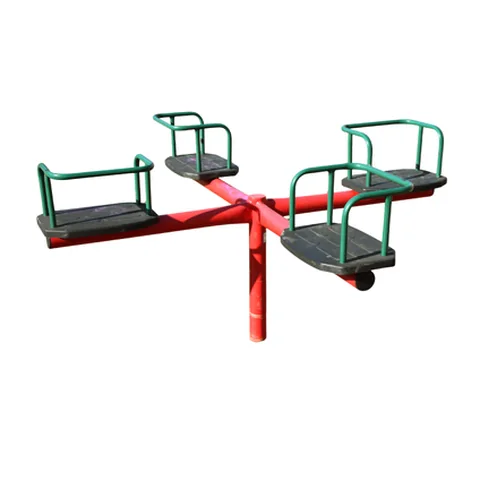
Karuzela Krzyżowa
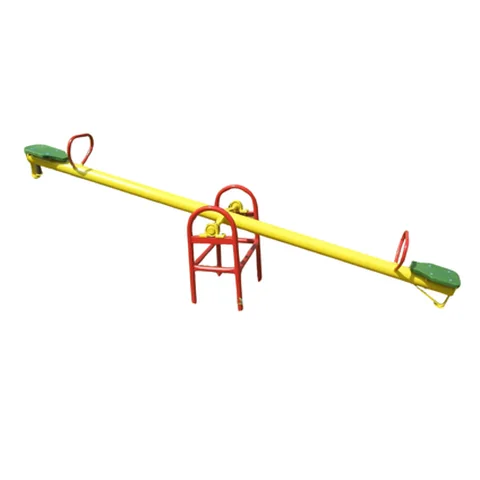
Huśtawka Ważka
Need certified equipment?
We make carousels and seesaws in Rogowo, Poland. EN 1176 certificate and the full paperwork included, free delivery across Poland, 7 working days lead time.
Read next
EN 1176 certificate: what it covers and who asks
An EN 1176 certificate is what a school, municipality or insurer asks for before use. What it covers, how it differs from a declaration, what is included.
Safety and standardsPlayground inspections: how often and by whom
EN 1176-7 sets out three inspection levels: routine visual, operational every 1-3 months and an annual main inspection. The duty sits with the operator.