EN 1176 certificate: what it covers and who asks
The question about certification comes up in the first three sentences of almost every sales call. Fair enough, because without that paperwork nobody signs the equipment off.
A kindergarten head ringing for a quote almost always opens with the same question: does it come with a certificate. There is a specific situation behind that question. In a few weeks somebody will arrive, ask for the documentation, and if it is not there the unit gets taped off.
An EN 1176 certificate confirms that the design of a piece of playground equipment meets the European safety standard. A testing body issues it after examining the design and the workmanship. Without it the unit will not be accepted at handover by a municipality, a school or a kindergarten.
Where EN 1176 applies
EN 1176 is a European standard adopted across the EEA and published nationally under local prefixes: PN-EN in Poland, ČSN EN in the Czech Republic, STN EN in Slovakia. The technical content is the same in each case, so a certificate issued against EN 1176 carries the same meaning on either side of the border. Outside the EU the standard has no legal force of its own, but it is the reference most tender documents and most insurers reach for, because there is no competing European document.
What the standard actually checks
EN 1176 is not a single document but a family of parts. Three of them matter to a maker of carousels and seesaws:
- Part 1, general requirements: materials, edge finishing, gaps a child could push a finger or a head into, structural stability, free fall height.
- Part 5, carousels: permitted speeds, clearances between moving and fixed parts, the safety zone around the unit.
- Part 7, installation, inspection, maintenance and operation. That part is addressed not to the manufacturer but to the owner of the site, because the periodic inspection regime comes from it.
Most of the findings in testing concern details that look harmless from a distance: a tube cut off too sharply, a gap 9 millimetres wide that will trap a finger, a bolt left protruding. The standard puts a specific limiting dimension on each of those cases, which is why an assessment is a measuring exercise rather than a matter of opinion.
Certificate and declaration of conformity are not the same thing
The two get used interchangeably in conversation, but in a handover file they mean different things. The certificate is the result of an external body testing a particular design. The declaration of conformity is the manufacturer stating that the unit delivered to you matches that tested design. Both are normally needed when an investment is signed off, and asking for only one of them is the most common gap we see in documentation.
What should travel with the equipment
The set of documents that gets a unit through a technical handover looks like this:
- EN 1176 certificate
- Declaration of conformity issued by the manufacturer
- Assembly manual with the foundation drawing
- Technical data sheet for the unit
- Invoice
With us that set goes out with every order, at no extra cost and without anyone having to ask. A missing sheet of paper means a suspended handover, and handovers usually have a date written into a contract.
Whoever you buy from, ask for a scan of the certificate before you pay rather than after delivery. The phrase „we will send the certificate later" is often the start of a long correspondence.
The certificate does not replace inspections
This is the most frequent misunderstanding on the buyer's side. The certificate describes the design of the unit at the point of manufacture. It says nothing about the state it is in after two seasons of use.
The condition of the equipment is the responsibility of the owner or the operator of the site, and it is the operator who arranges the checks set out in part 7 of the standard: routine visual inspection, an operational inspection every 1 to 3 months, and an annual main inspection. We have written about that regime separately in the piece on playground inspections, because it comes back in every conversation about liability.
What a certificate does not cover
A certificate is about safety of the structure, not about how long it will last. Corrosion resistance, the coating system, the quality of the bearing and the availability of spare parts sit outside its scope entirely. A unit can be fully compliant with EN 1176 and still be painted straight onto bare steel, which is a durability question rather than a safety one. We cover the difference in the piece on powder coating and galvanising.
The certificate also says nothing about where the unit stands. Correct spacing is checked on site after installation and it is the buyer, not the manufacturer, who chooses the spot.
Equipment installed years ago
Municipalities often have a carousel put up in the nineties and ask whether it has to go. The standard does not apply retrospectively, but responsibility for safety does. If an inspection finds gaps or edges that no longer meet current requirements, the operator has to take the unit out of use or bring it into line. With structures from that period, replacement usually works out cheaper than modification, mostly because the entrapment gaps sit in the geometry of the frame rather than in a part you can swap.
Every carousel and seesaw we make ships with an EN 1176 certificate and a declaration of conformity, at no extra charge, together with the assembly manual and the technical data. Free courier delivery across Poland, 7 working days from order, 2 years of manufacturer warranty. Shipping to the Czech Republic and Slovakia costs an extra 1000 zł. See the four units with prices or send us the site dimensions through the enquiry form and we will tell you what fits.
Short answers
What is EN 1176?
It is the European safety standard for playground equipment. It comes in several parts: general requirements plus separate parts for swings, slides, rotating equipment and for installation, inspection and maintenance.
Is an EN 1176 certificate compulsory?
The standard itself is not a law. Conformity with it is required in practice by public buyers, by insurers and by whoever carries out the post-installation inspection. Without a certificate the unit will not go onto a municipal, school or kindergarten site.
Does the certificate expire?
It applies to the design of the unit and carries no shelf life. Periodic inspections are a separate obligation and the certificate does not replace them.
Which documents should I receive when I buy?
An EN 1176 certificate, a declaration of conformity from the manufacturer, an assembly manual with the foundation drawing, the technical data sheet and an invoice. That is the set an inspector expects at handover.
Does an EN 1176 certificate count outside Poland?
Yes. EN 1176 is a European standard adopted across the EEA, so a certificate issued against it means the same in the Czech Republic or Slovakia as it does in Poland. Outside the EU it is usually accepted as the reference in tender documents.
What this is based on
- EN 1176-1: playground equipment, general safety requirements
- EN 1176-5: additional requirements for carousels
- EN 1176-7: guidance on installation, inspection, maintenance and operation
- General guidance for playground owners and site managers
Equipment mentioned in this article
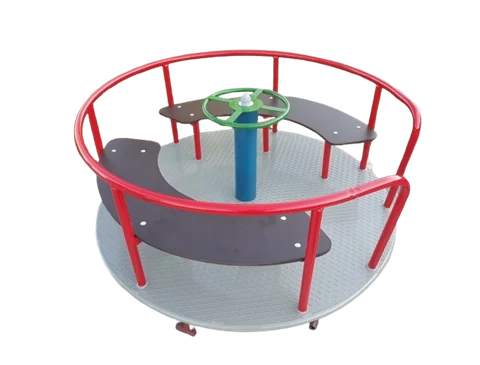
Karuzela Kołowa Trzmiel
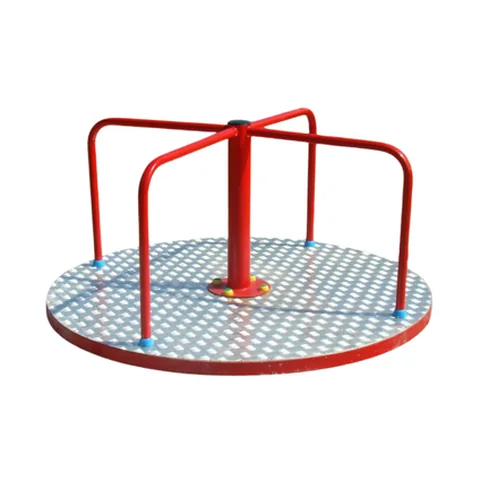
Karuzela Tarczowa
Need certified equipment?
We make carousels and seesaws in Rogowo, Poland. EN 1176 certificate and the full paperwork included, free delivery across Poland, 7 working days lead time.
Read next
Playground inspections: how often and by whom
EN 1176-7 sets out three inspection levels: routine visual, operational every 1-3 months and an annual main inspection. The duty sits with the operator.
Safety and standardsPlayground safety zone: how much ground you need
A carousel measuring 150 × 150 cm needs 550 × 550 cm of clear ground, over 30 m². Where that figure comes from and what must not stand inside the zone.