Playground surfacing: sand, gravel, chips or grass
One number decides whether several thousand zloty gets added to the budget: the free fall height of the unit. Worth checking before you buy rather than after.
A municipality budgets for a playground: two units at five thousand each, ten thousand in total. Then it emerges that one of them needs surfacing underneath at a cost of fifteen thousand. The whole estimate has to be rewritten.
Whether surfacing is required is decided by the free fall height. That is the distance from the highest point a child can stand or sit on down to the ground. Above 60 cm, EN 1177 requires impact attenuating surfacing with tested performance. Below it, grass is enough.
Check this number before you buy
The free fall height is given in the technical data sheet for the unit. It is one of those figures some sellers leave out of the description, even though it decides a difference of several thousand zloty in the budget.
| Type of unit | Typical fall height | Surfacing |
|---|---|---|
| Platform carousel (disc, round) | about 45 cm | not required |
| Cross carousel | about 45 cm | not required |
| Post carousel with raised seats | about 70 cm | required |
| Slide, multi play unit | usually over 100 cm | required |
Indicative values based on published sheets for equipment in the same class. Always check the figures for the particular model.
How the requirement is actually tested
EN 1177 does not describe surfaces by name. It describes performance. A sample of the material is tested by dropping an instrumented headform onto it from increasing heights, and the height at which the measured deceleration passes the accepted limit becomes the critical fall height of that material at that depth. A surface is suitable if its critical fall height is at least equal to the free fall height of the equipment above it.
Two things follow from that, and both get missed on site. First, depth matters as much as material: the same sand at half the depth is a different surface with a lower critical fall height. Second, loose fill migrates, so the standard expects an extra allowance on top of the tested depth to cover what gets kicked, dug and washed out between inspections. A surface that met the requirement on the day of installation stops meeting it once the layer under the busiest spot has thinned out.
Four kinds of surfacing
Sand
Cheapest to buy and the most widely used. It needs the right grading, washed and free of fines, and the right layer depth. A thin layer attenuates nothing. Drawbacks: it scatters beyond the zone, it compacts over time so it has to be turned over, and on open sites it collects litter. The layer needs topping up and periodic replacement.
Washed gravel
Similar price, better drainage, does not compact the way sand does. Less comfortable for the youngest children, who sit down on the surface. It also needs topping up.
Wood chips
Good attenuating performance and a natural look. They decompose, so the layer has to be renewed every few years, and in wet conditions they mat together into a crust which attenuates far less than loose material. Anything decomposing also loses depth quietly, without anyone noticing.
Poured polyurethane and rubber tiles
The most expensive to install and the cheapest to keep. Nothing scatters, nothing needs raking, and it looks the same for years. On larger sites this is usually the better long term choice, but the entry cost is high. We are talking a few hundred zloty per square metre, and the impact area around a single unit can run to thirty.
Surfacing has to cover the whole impact area, not just the ground directly under the unit. For a carousel with a footprint of 150 × 150 cm that is a rectangle of 550 × 550 cm, over 30 square metres. At 300 zł per square metre that comes to about 9 000 zł, more than the carousel itself. How the zone is measured is set out in the piece on the playground safety zone.
When grass is enough
For units with a free fall height below 60 cm, which covers most platform carousels, the standard requires no impact attenuating surfacing. The unit can stand on a grassed area and that is fully compliant.
This is one of the reasons carousels turn up on public sites more often than tall multi play structures: the whole cost of the investment closes at the price of the unit and its foundation, with no rebuilding of the ground. It also removes a recurring maintenance job from a budget that usually has no line for maintenance at all.
Grass is not maintenance free, though. Under a busy unit it wears down to bare earth within a season and that earth then compacts. Compacted ground is harder than the grass it replaced, so on a busy site it is worth planning either to rotate use or to lay a surface, even where the standard does not demand one.
Drainage decides how long any of it lasts
Whatever goes down, water has to leave. Loose fill sitting in a hollow turns into a bath, freezes in winter and loses its attenuating properties entirely when frozen. A poured surface laid on a base that holds water lifts at the edges. The build up under the surface, the base layer and the falls, costs a fraction of the surface itself and decides whether it lasts three years or ten.
A practical order of decisions
- Check the free fall height of the unit you are interested in.
- If it is below 60 cm you need no surfacing, so the budget is the price of the unit plus the foundation.
- If it is above, work out the area of the impact zone and multiply it by the price of the surface you have chosen.
- Compare the two routes. A cheaper unit that needs surfacing often costs more in total than a dearer one that does not.
All our carousels are platform designs. The differences between the three of them, including how much cleaning each one needs once the leaves start falling, are set out in the comparison of carousel types.
If you need the free fall height of a particular model for an estimate or a design, write to us and we will send it the same working day. Every unit ships with an EN 1176 certificate and a declaration of conformity, free courier delivery across Poland, 7 working days from order. See the four units with prices or call 507 440 718, every day from 08:00 to 20:00.
Short answers
When is impact attenuating surfacing compulsory?
When the free fall height of the unit is over 60 cm. Below that figure the standard requires no special surfacing and the equipment may stand on grass.
Does grass count as impact attenuating surfacing?
Not in the sense of EN 1177. Grass and compacted ground have no tested attenuating performance. For units below 60 cm, grass is still an acceptable base.
Which is cheaper, sand or a polyurethane surface?
Sand, by a wide margin, at the point of purchase. Over time the gap narrows, because sand has to be topped up, raked and periodically replaced. A poured surface costs many times more to install and then needs almost nothing.
What is the free fall height of a carousel?
Platform carousels are usually around 45 cm, below the threshold. Post carousels with raised seats can reach 70 cm and then surfacing is required. Check the data sheet for the specific model.
How large an area does the surfacing have to cover?
The whole impact area, not just the ground directly under the unit. For a carousel with a footprint of 150 × 150 cm that means a rectangle of 550 × 550 cm, over 30 square metres.
What this is based on
- EN 1177: impact attenuating playground surfacing, determination of critical fall height
- EN 1176-1: playground equipment, general safety requirements
- General guidance for playground owners and site managers
Equipment mentioned in this article
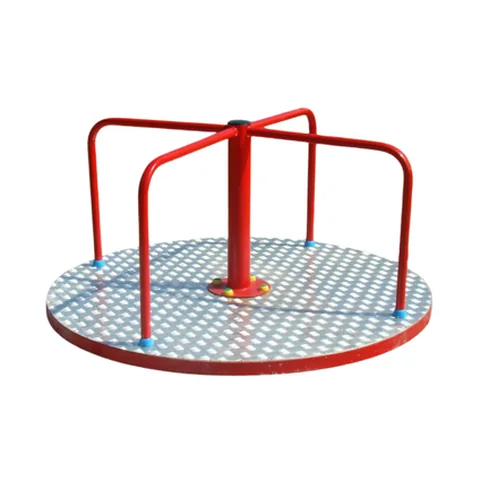
Karuzela Tarczowa
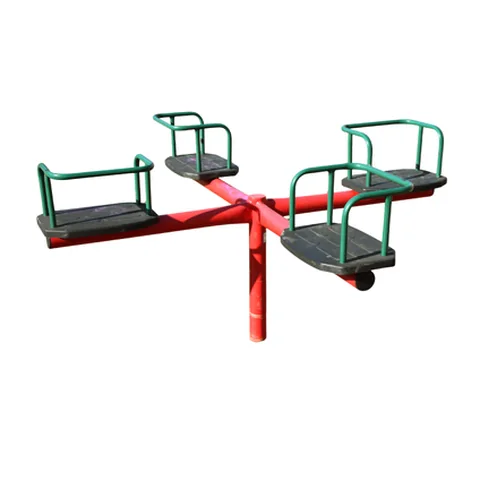
Karuzela Krzyżowa
Need certified equipment?
We make carousels and seesaws in Rogowo, Poland. EN 1176 certificate and the full paperwork included, free delivery across Poland, 7 working days lead time.
Read next
EN 1176 certificate: what it covers and who asks
An EN 1176 certificate is what a school, municipality or insurer asks for before use. What it covers, how it differs from a declaration, what is included.
Safety and standardsPlayground inspections: how often and by whom
EN 1176-7 sets out three inspection levels: routine visual, operational every 1-3 months and an annual main inspection. The duty sits with the operator.