Powder coating and galvanising: what stops rust
Rust does not start with rain. It starts with one chip the size of a fingernail, and with whatever sits directly underneath it.
Two carousels, both painted the same yellow, both after four seasons on the same housing estate. On one of them a scratch from a bicycle handlebar looks like a scratch. On the other, a rust streak is running out of the same scratch and the paint around it is starting to lift. The difference is in a layer you cannot see on either of them.
Zinc and powder coating protect steel in two completely different ways, and together they last longer than either does alone. The coating is a barrier separating the metal from water and oxygen. Zinc is electrochemical protection that keeps working even after the barrier has been punctured. Which is why, with powder coated playground equipment, what matters is not the fact of it being painted but what is underneath the paint.
How zinc works
Zinc is less noble than iron. In the presence of moisture, meaning in any outdoor conditions, a cell forms in which the zinc gives up electrons and the steel is left untouched. The protection works by sacrificing the zinc, which corrodes instead of the steel, rather than by simply covering it. This is called cathodic protection and it explains the most useful property of the coating: zinc also protects areas of steel it does not physically cover, provided the exposed area is small.
In practice that means a scratch a few millimetres wide does not start rusting, because the zinc around it takes the corrosion on itself and its products gradually seal the exposed spot. On bare steel the same scratch is the starting point for rust that gets under the coating and spreads sideways.
Zinc is consumed at a rate that depends on how aggressive the surroundings are. In clean rural air the loss is very slow; in a town with traffic and roads salted in winter it is markedly faster. EN ISO 12944 classifies this through corrosivity categories of the environment, from rural areas through to industrial and coastal zones. Zinc on its own, with no paint over it, has one practical drawback: it greys with time and cannot be had in a colour.
How powder coating works
A powder coating is formed differently from brushing or spraying liquid paint. The process has three stages and each of them affects what you end up with.
First, surface preparation: degreasing, removing contamination and zinc corrosion products, and creating a layer that gives adhesion. This is the stage where it is easiest to cut corners and hardest to see that anyone has, because the consequence only appears two seasons later, as paint coming away in sheets.
Then application. Dry polymer powder is charged electrostatically and sprayed onto the earthed part, where it clings through the difference in potential. There are no solvents, so there is no evaporation and none of the shrinkage that goes with it.
Finally, curing in an oven. The powder melts, flows out into a continuous film and cross-links, forming durable bonds between its molecules. That is where the hardness of the coating comes from, and its resistance to impact, which is considerably higher than a single coat of liquid paint. For outdoor use, polyester powders are used because they resist ultraviolet light. Epoxy powders are hard and adhere well, but they chalk and lose colour in sunlight, so their place is indoors.
The technology has one price attached: repairs cannot be made on site. Powder needs an oven, so damage on an installed carousel is put right with liquid touch up paint rather than with the same coating it left the factory with.
Why the order of the layers decides everything
Zinc under paint and paint under zinc are two different constructions, even though the ingredients are the same. Only one order makes sense: galvanise the steel first, powder coat it afterwards.
Then each layer does something the other cannot. The paint shields the zinc from direct contact with water, acidic rain and chlorides, so the zinc is consumed more slowly than it would be if exposed. The zinc waits underneath for the moment the paint is punctured and then takes over the work. Two layer arrangements of this kind, described as duplex systems, last longer than the simple sum of the service lives of the two coatings taken separately.
Powder coating applied straight onto steel, with no zinc, gives the same appearance and the same texture. The difference only shows at the first serious piece of damage, and on a playground such damage is a question of when rather than whether. So the question to put to a supplier is not whether the equipment is powder coated, but what is under that coating.
Painting a galvanised part calls for its own surface preparation technology, described in EN 13438. Zinc is smooth and chemically active, so paint does not key to it the way it keys to mechanically prepared steel. With hot dip coatings there is also a pre-bake before painting, which drives out gases trapped in the layer. Skip that step and you get blisters and small craters, visible only after curing.
Three systems side by side
| Coating system | What happens at a chip | Colour | Where it works |
|---|---|---|---|
| Paint on bare steel | Corrosion starts at once, gets under the coating and spreads sideways, lifting the paint | Any, needs redoing every few years | Parts under cover, temporary structures |
| Galvanising alone, no paint | Nothing happens, the coating restores protection at the point of damage | Grey, dulls with time | Crash barriers, technical structures where colour is irrelevant |
| Galvanising plus powder coating | Zinc is exposed rather than steel, corrosion does not creep under the coating | Full range, durable and UV resistant with polyester powders | Playground equipment, structures exposed all year round |
What happens at a chip, step by step
It is worth following this through, because the difference between the systems shows up here most clearly. The start is identical: an impact exposes metal over an area the size of a grain.
On steel painted without zinc, a corrosion site forms at the exposed spot. Rust has a greater volume than the steel it came from, so it pushes the coating up from below and lifts it around the edges of the defect. What follows is undercutting, a process advancing beneath the paint and invisible from outside apart from a slight bulge. After a few seasons the area affected by corrosion is many times larger than the original damage.
On galvanised and powder coated steel, what is exposed is zinc. It begins to corrode sacrificially, protecting the edges of the exposed steel, and its products fill the void. The paint around it does not lift, because nothing is pushing it up. The damage stays cosmetic and does not turn into a structural problem.
That does not mean nothing needs doing. Zinc at the exposed spot is used up faster, because it is working without the shelter of the paint, and at the base of a post, where water collects along with salt off de-iced paths, the rate is noticeably higher. That base zone is the first place to look at after winter on any unit standing near a road or a gritted footpath.
How to repair damage
The repair is simple and fits inside the routine of an operational inspection. The whole job is four steps:
- Remove loose fragments of coating and dirt from the damaged area and from immediately around it.
- Dry and degrease the surface, because touch up paint applied to damp or greasy metal will not bond and will come away with the first frost.
- Apply touch up paint in the colour of the unit in a thin layer, in dry, warm weather, allowing the drying time stated by the maker of the product.
- Record the repair in the site file, with the date and the location.
Where the damage is deep and goes past the zinc down to the steel, the sensible answer is a zinc rich primer under the colour coat, because that restores the electrochemical protection rather than merely covering the defect. Products of this type are sold in builders merchants, and EN ISO 1461 expressly provides for repairing a zinc coating by this method.
As a task it falls quarterly, alongside the visual check of the coating, which is one of the points covered in the piece on playground inspections.
What to ask a supplier
Product descriptions rarely go into this level of detail, so the questions have to be asked. Five of them are enough to tell equipment that has been built properly from equipment that photographs well:
- Is the steel galvanised under the paint, or painted directly
- What kind of powder is used on parts intended for outdoor use
- Does the order include touch up paint in the colour of the unit
- Will spare parts still be available in a few years
- Does the unit have an EN 1176 certificate and a declaration of conformity, and are they included in the price
That last point is a common source of confusion, because a certificate covers the safety of the structure, not the durability of the coating. What such a document actually confirms is set out in the piece on the EN 1176 certificate. The wider comparison of materials, with ten years of upkeep costs, is in the piece on steel or timber on a playground.
Colour, temperature and perforation
Powder coating gives the full range of colours, but on playground equipment the choice of shade has a side effect. Dark, smooth, large surfaces heat up most in full sun, and that describes exactly the parts a child sits or stands on.
Which is why the platforms on our carousels are made from perforated sheet. The holes reduce the contact area and improve heat exchange, so the platform gets less hot than a smooth panel would, and as a bonus it drains water and dries faster after rain. Water that does not stand on a surface also has no chance to freeze in a hollow and work there through the winter.
Our carousels and seesaws are made from galvanised steel, powder coated, with perforated sheet platforms. Every unit comes with an EN 1176 certificate and a declaration of conformity at no extra cost, the manufacturer warranty against material and manufacturing faults runs for 2 years, and courier delivery across Poland is free with a lead time of 7 working days. See the four units with prices or call 507 440 718, we answer every day from 08:00 to 20:00.
Short answers
Is powder coating enough on its own, without galvanising?
Only until the first deep scratch. Powder coating is a barrier, and a barrier works as long as it is unbroken. With no zinc underneath, a scratch exposes bare steel and corrosion starts spreading under the coating.
How does powder coating differ from ordinary painting?
The powder is applied dry and electrostatically, then cured in an oven, where it forms a single cross-linked film with no solvents. The result is thicker and harder than one coat of liquid paint, but a local repair on site has to be done with touch up paint rather than powder.
What should I do about a chip in the coating on a carousel?
Clean the loose coating and dirt away, dry and degrease the spot, then apply touch up paint in the colour of the unit in dry, warm weather. On galvanised steel there is zinc under the paint, so you have until the next round of checks rather than until tomorrow.
Where does the white deposit on a galvanised part come from?
Those are zinc corrosion products, commonly called white rust, forming where water stands without access to air, for instance between tightly stacked parts. It does not weaken the structure, but it has to be removed anywhere that is going to be painted, because paint will not hold on it.
What colour should playground equipment be?
Any colour from the coating range, with one reservation: dark, smooth, large surfaces get hottest in full sun, and those are exactly the parts a child sits or stands on. Seats and platforms are better in lighter shades or in perforated sheet.
What this is based on
- EN ISO 1461: hot dip galvanised coatings on fabricated iron and steel articles
- EN ISO 12944: corrosion protection of steel structures by protective paint systems
- EN 13438: organic powder coatings for galvanised steel products
- EN 1176-1: playground equipment, general safety requirements
Equipment mentioned in this article
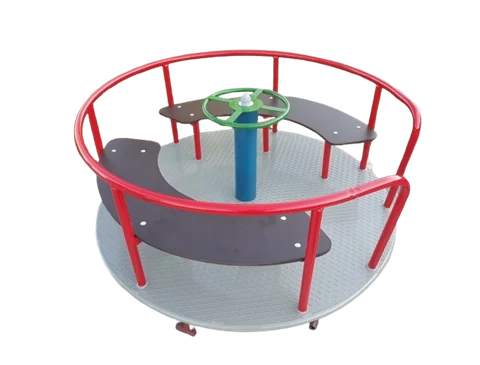
Karuzela Kołowa Trzmiel
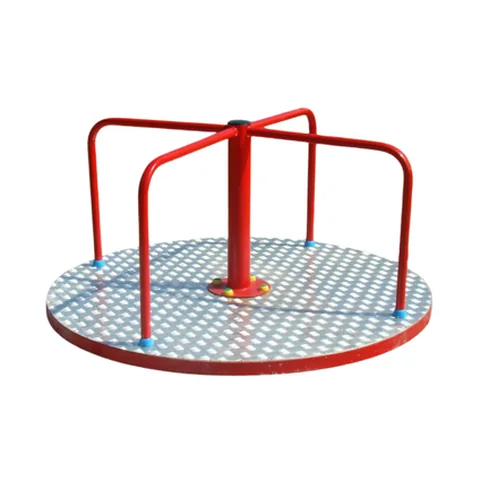
Karuzela Tarczowa
Need certified equipment?
We make carousels and seesaws in Rogowo, Poland. EN 1176 certificate and the full paperwork included, free delivery across Poland, 7 working days lead time.
Read next
How many children fit on a carousel: capacity, age
Load capacity is stated in kilograms, not in children. How to turn 160-200 kg into a number of children, what limits the places and why an adult upsets it.
Choosing equipmentRound, cross or disc carousel: which one to choose
The three types of carousel differ in load capacity, the ages they suit and how much ground they take. A side by side table plus what works where.