Steel or timber playground: durability and upkeep
Timber wins on the photographs, steel wins in the fifth season. The whole difference comes down to who is going to look after it for the next decade.
Councillors look at two visualisations. One shows a timber castle, the other a steel carousel. The castle wins because it looks better. Five years later somebody else is looking for money to replace the posts, which have started to rot at ground level.
Galvanised, powder coated steel needs less work across its whole service life; timber looks better and sits more comfortably in a park setting. A steel structure stands for well over a decade with no intervention beyond tightening its connections. Timber needs its coatings renewed every one to three years and regular checks where it meets the ground, which is where it fails first.
Side by side
| Criterion | Galvanised and powder coated steel | Timber |
|---|---|---|
| Maintenance | Tightening connections, touching up chips in the coating | Treatment or repainting every 1-3 years |
| Weak point | Corrosion where the coating has been broken | Rot at ground level, shrinkage cracks |
| Vandalism | Resistant, scratches do not weaken the structure | Open to carving, scorching, boards being pulled off |
| Temperature in sun | Higher on dark, smooth surfaces | Lower |
| Appearance | Technical, colours from the coating range | Natural, suits green settings |
| Repairing one part | Replacement part from the maker | Often a whole beam or board |
Where timber actually fails
Not on the surface, but at the ground. The zone where a post meets the soil stays damp, and that is where decay begins, usually invisible from outside for the first few years. The element looks sound and is already soft underneath.
This is what the use classes in EN 335 are about. Timber in permanent ground contact sits in the most demanding class there is, and it is the only part of a structure exposed to both moisture and soil organisms at the same time. Good design keeps the timber out of the ground entirely, on galvanised steel shoes set into the concrete, so that the post ends above grade and can dry. Where posts are concreted in directly, the service life of the whole unit is decided by its worst twenty centimetres.
Which is why inspecting timber equipment cannot be a matter of looking at it. The hardness of the timber is tested in the ground zone, for instance by pushing a blade in at the base of a post. It is one of the checks most often skipped, and it belongs in the annual main inspection described in the piece on playground inspections.
The second typical problem is shrinkage cracking. Timber moves with the humidity of the air, and the splits that open up can catch fingers and hold water. Water sitting in a split then freezes, which widens it, and the cycle repeats every winter.
Where steel fails
In one place: wherever the coating has been broken. A chip in the paint exposes the steel and corrosion starts from there.
The order of the protective layers is what decides how serious that is. A structure that is galvanised first and powder coated afterwards has two layers of protection, and damage to the paint exposes zinc rather than steel. An element painted straight onto steel loses its protection with the first deep scratch, and the rust then spreads under the coating and can weaken the section within a few seasons. The mechanism behind that is set out in the piece on powder coating and galvanising.
Sealing a chip with touch up paint takes a few minutes and closes the matter for years. A neglected chip on a structure with no zinc under the paint costs a replacement part.
Fixings are the part nobody compares
A timber structure is held together by steel: bolts, plates, brackets, post shoes. Those fixings work in wet timber, which is an aggressive environment for them, and a corroded bolt in a sound beam is as much of a defect as a rotten beam with a sound bolt. Galvanised fixings are the minimum here, and they are also the first thing to check when a timber unit starts to feel loose. On a steel structure the fixings and the frame are the same material with the same coating, so they age at the same rate.
The cost over ten years
The purchase price of the two options is often similar. What diverges is the cost of keeping them, and that is the number nobody works out when the decision is being made.
For a timber unit, assume the coatings are renewed every one to three years, whether in labour or in materials, plus replacement of the elements that did not survive. For a galvanised steel unit what remains is tightening the connections during the operational inspection and spot repairs to the paint. Moving parts, meaning the bearing of a carousel or the suspension of a swing, wear out regardless of what the frame is made of.
The question worth asking at the point of purchase is not what the unit costs, but what has to be done to it every year and who will do it. A municipality, a school or a managing agent rarely has anyone on hand for routine timber maintenance, so in practice it means contracting the work out or not doing it at all.
Surface temperature
This argument comes up often and deserves an honest answer: metal in full sun gets hotter than timber. The difference concerns dark, smooth, large surfaces above all, and those are exactly the elements a child sits or stands on.
Which is why platforms are made from perforated or treadplate sheet rather than a smooth panel, and the darkest shades are kept off seats. On a carousel that has a second benefit: the perforation drains water, so the platform dries faster after rain and nothing is left standing to freeze in a hollow over winter.
Safety does not depend on the material
Whether a unit is safe is decided by conformity with EN 1176: no entrapment gaps, no sharp edges, correct heights and safety zones. An uncertified timber carousel is exactly as unsafe as an uncertified steel one.
In practice, timber left without maintenance creates one risk that a steel structure does not: splinters and flaking at the surfaces children put their hands on.
When to choose timber
- When the site is in a park, next to a listed building, or anywhere visual coherence matters
- When there is somebody to look after it, for example a municipal works team with a crew and a schedule
- When the unit is large and multi functional and does not stand somewhere exposed to vandalism
When to choose steel
- When nobody will be carrying out annual maintenance
- When the site is open and unsupervised
- When the unit has moving parts, because there stiffness and repeatable manufacture are what count
- When the budget is a one off and makes no provision for spending in later years
That last point covers most public purchases. The money is there for the purchase; for upkeep there is usually none at all, and a unit that needs annual work then goes without it. A structure that tolerates being ignored is worth more on such a site than one that would look better if only somebody maintained it.
We make carousels and seesaws from galvanised steel, powder coated. Perforated sheet platforms, colour of your choice, EN 1176 certificate and 2 years of manufacturer warranty with every unit. Free courier delivery across Poland, 7 working days from order; assembly with our own crew is charged at 2,50 zł per km one way from Rogowo. See the offer with prices or write through the enquiry form.
Short answers
What lasts longer on a playground, steel or timber?
Galvanised, powder coated steel. It does not rot, it does not split and it needs no annual treatment. Timber fails fastest where it meets the ground, where it stays permanently damp.
What does a timber playground cost to maintain?
The main cost is re-treating or repainting every 1-3 years, plus replacing parts that have started to rot. With steel equipment upkeep comes down to tightening connections and touching up chips in the coating.
Does steel equipment get hot in the sun?
Powder coated surfaces in light colours warm up moderately. The highest temperatures occur on dark, smooth elements in full sun, which is why seats and platforms are made from perforated sheet or in lighter shades.
Is timber safer for children?
No. Safety is decided by conformity with EN 1176, not by the material. Untreated timber can produce splinters and cracks that a steel structure does not have.
Which is better in a park setting?
Timber, if there is someone to maintain it. It fits a green or historic setting better, and that argument is worth something. It only holds where a maintenance routine and a budget for it actually exist.
What this is based on
- EN 1176-1: playground equipment, general safety requirements
- EN 1176-7: guidance on installation, inspection, maintenance and operation
- EN 335: durability of wood and wood-based products, use classes
Equipment mentioned in this article
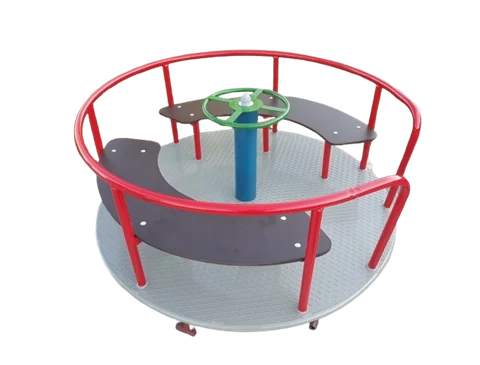
Karuzela Kołowa Trzmiel
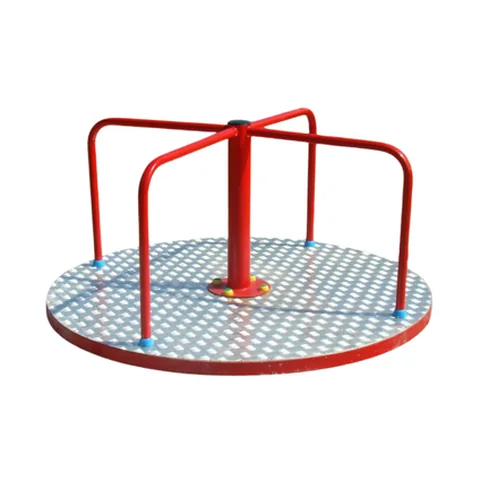
Karuzela Tarczowa
Need certified equipment?
We make carousels and seesaws in Rogowo, Poland. EN 1176 certificate and the full paperwork included, free delivery across Poland, 7 working days lead time.
Read next
How many children fit on a carousel: capacity, age
Load capacity is stated in kilograms, not in children. How to turn 160-200 kg into a number of children, what limits the places and why an adult upsets it.
Choosing equipmentRound, cross or disc carousel: which one to choose
The three types of carousel differ in load capacity, the ages they suit and how much ground they take. A side by side table plus what works where.